I would like to share a few bits of information I've gathered from around the web about space and aliens and the like. We'll start with a brief history lesson regarding the Voyager space probes.
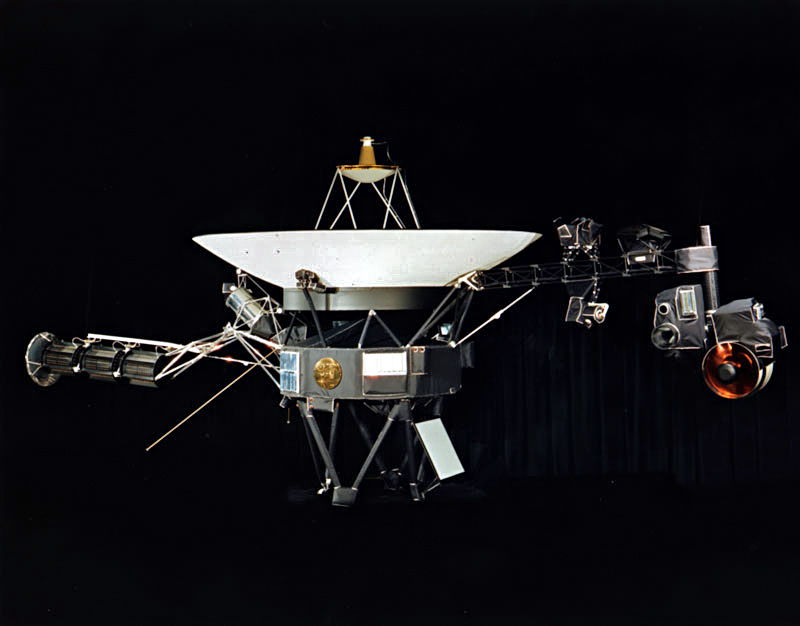
In 1977 (the same year that brought us Star Wars), the Voyager 1 and Voyager 2 space probes were launched for deep space exploration. Voyager 2 was the first (and only) probe to take a close-up look at Uranus and Neptune, and Voyager 1 is the furthest human-made object from Earth. They are currently just a few years from exiting our solar system.
They carried, in addition to all the sensory stuff, a sampling of music and greetings in fifty-five languages, in case extra-terrestrial life ever found them.
In 1979, Star Trek: The Motion Picture hit theaters. Let's get one thing clear: the television show Star Trek started airing in 1966, eleven years before any of that Star Wars plagiarism. Anyway, the premise of ST:TMP was that some advanced alien race had found one of the Voyager probes and repaired it with their own technology, in the process giving it sentience and causing it to come back to Earth looking for its creator. In the Star Trek novel The Return, William Shatner claimed the aliens that modified Voyager (or V'ger, as it called itself, because the "OY" had been scratched off and apparently its self-identification was based on its hull markings) were Borg, but it's usually best to ignore anything William Shatner writes.
Or directs, so you can go ahead and ignore Star Trek V.
To be fair, the Voyager probe in question in ST:TMP was Voyager 6, but bear with me here.
In April of this year, Voyager 2 started sending back information in an unknown data format. You know, like if you send your professor a .odt, but he doesn't have OpenOffice. Wikipedia calls this "scientific data format problems," but alien expert Hartwig Hausdorf (the perfect name for someone in a generally discredited profession) suggests the probe has been hijacked. As in, some alien race is sending us their term papers, but we're using different word processors. Kinda freaky in light of that whole Star Trek thing, right? Especially since it almost meant the destruction of Earth. Actually, kinda freaky regardless.
But there's one more thing I want to tie in to all this. This data corruption--or hijacking--happened just three days before Stephen Hawking (you know, the astrophysicist slash smartest person ever to cameo in Star Trek) warned that instead of seeking out alien life, we should be doing everything we can to avoid contact. He speculates that intelligent life we meet could well be nomadic, looking for new worlds to conquer and strip of resources before moving on (not that it wouldn't have some poetic justice in it). If that also sounds like a movie plot, it's because it is.
So basically we're all going to die. There is no possible way we would be prepared to fight off aliens capable of interstellar travel, so we might as well just accept it.
BUT, in case we do meet intelligent life that isn't just interested in a delicious new planet or paving a new intergalactic highway, and in case you happen to be the person who makes first contact, you should probably be prepared. To this end, the folks over at io9 have posted this comprehensive guide for how to make first contact with extra-terrestrial life.
If you're in danger of not sleeping because of all this Voyager 2 creepiness, go ahead and read the "current status" section of the Wikipedia article on Voyager 2.
Wednesday, June 09, 2010
Saturday, June 05, 2010
Of months and summers
It has been less than a month since I last wrote, but still far too long. I get so caught up in everything but writing, I forget to write. Then I make new friends and read their blogs, and I am incredibly jealous of the poignancy with which they offer up their thoughts. Or perhaps just of the profundity of those thoughts.
Of course, I'm also appreciative of their beautiful minds and pens and keyboards. But still.
I think my problem is I'm always waiting for something--always putting something off, and justifying it by establishing some artificial boundary that makes my procrastination seem rational. I'll do my homework after I watch Stargate. I'll catch up on reading over the weekend. I'll eat better when my schedule allows.
So, summer is here. As of today, or as of Sunday, or at the very latest as of the 18th.
Of course, I'm also appreciative of their beautiful minds and pens and keyboards. But still.
I think my problem is I'm always waiting for something--always putting something off, and justifying it by establishing some artificial boundary that makes my procrastination seem rational. I'll do my homework after I watch Stargate. I'll catch up on reading over the weekend. I'll eat better when my schedule allows.
So, summer is here. As of today, or as of Sunday, or at the very latest as of the 18th.
- I'm going to run regularly.
- I'm going to eat real food.
- I'm going to do research.
- I'm going to write beautiful letters to beautiful people, starting with Tucker.
- I'm going to take naps in the grass.
- I'm going to do yoga. Even if it's bad yoga.
Friday, April 16, 2010
Writing to change the world
Credit Brandi on the post title. I was just reading her blog, of the same name.
In my Introduction to Theological Reflection class, we were given a semester-long assignment, called a "focal practice." First, we were to write a short "This I Believe" essay, then create a focal practice around that belief and write ten journal entries documenting our experience with the practice.
I wrote that I believe "God is in the silence." I talked about my desire--longing, really--for space and silence. These are things I never get, because when I'm not frantically trying to finish an assignment I started after most of my classmates had finished, I'm murdering time by playing stupid online games or watching the latest episodes of my favorite TV shows on Hulu.
As for a focal practice, I don't have one. I wrote about various things I did--attempts to cook, bike rides to school--things that make my life better, but that are not necessarily related in any focal sense. Then, today, while doing a shift at Bethany's front desk, I got overwhelmed with a desire to write. So I wrote the following:
In my Introduction to Theological Reflection class, we were given a semester-long assignment, called a "focal practice." First, we were to write a short "This I Believe" essay, then create a focal practice around that belief and write ten journal entries documenting our experience with the practice.
I wrote that I believe "God is in the silence." I talked about my desire--longing, really--for space and silence. These are things I never get, because when I'm not frantically trying to finish an assignment I started after most of my classmates had finished, I'm murdering time by playing stupid online games or watching the latest episodes of my favorite TV shows on Hulu.
As for a focal practice, I don't have one. I wrote about various things I did--attempts to cook, bike rides to school--things that make my life better, but that are not necessarily related in any focal sense. Then, today, while doing a shift at Bethany's front desk, I got overwhelmed with a desire to write. So I wrote the following:
I give myself "no credit" on this assignment.
I have failed to create any kind of focal practice. My writing here is reflective of a general theme in my life, which is a vague desire to be better in some way, accompanied by nothing more than fragmented half-attempts at doing something. So I tried to make broiled whitefish once. So I put together an altar. So I've been running. Sure, all of these things connect in my crazy post-modernist understanding of life and meaning and everything, but they aren't focal. And I'm not focused.
I face the same problem with writing. I'm a writer, kind of, except I don't write. And when I do, I don't write enough. I don't write enough to break out of the forced text and cliche and into something that will actually bring meaning to my own life, let alone to other peoples' lives. In writing, I start a new project wanting to name some kind of profundity, but then the ADHD sets in and I find myself entirely incapable of narrowing my vague creative desires down into something with focus.
A few weeks ago I stumbled across a guide to making a tape-less, staple-less booklet by cutting and folding paper. So I took some scraps of paper, put them together, and wrote "confessions" on the front. And I started to write.
Of course, this project is yet another one that has no focus. No boundaries. It's not "confessions" in the sense of "forgive me, father, for I have sinned." It's a confessional. I want to say, "This is who I am. This is what I think. This is what I'm going through." And, you know, it doesn't really have to have focus. Because it's just for me. It's just a little notebook where I can scribble some things down.
So I wrote about my lack of focus. My struggles with a learning disability. My recent separation from my partner of over a year. My theology of appeasement. My inability to follow through on anything, ever. Maybe when I'm done I'll tear it up. Maybe I'll put it in a box to read when I'm fifty. But at least I'm making something.
Maybe I'm not a writer in action--at least not as much as I should be--but I am a writer in belief. I believe that through writing I can mold the disjointed events of my life into a story. I can create meaning where none was inherent. I can process the things that whiz by me when I'm too distracted to stop and deal with anything.
I think writing changes the world, but not by being famous, unless you're Karl Marx or something. Writing changes the world by providing a lens I need to experience the world. It's a change of interpretation.
Maybe this post has nothing to do with the guidelines of this focal practice assignment. But I felt like writing it.
Subscribe to:
Posts (Atom)